
Table of contents
Storage
The blocks should be laid on bastaings or pallets to avoid overhangs that could damage some of the blocks.
Blocks must be stored on level, clean ground to avoid soiling in the event of rain.
If it rains or if the blocks are stored for a long time, it is advisable to wrap them to prevent them becoming overweight during assembly (which can double in the presence of water) or in the presence of mud (not recommended for coatings). The presence of water will not facilitate cutting or gluing.
However, water has no impact on the quality of the wood/cement fibre. As the block is mineralised with lime, the wood is rot-proof.
Structural work
Flow station
A cutting station will have to be adapted to the constraints of the site, to enable tracing, perfect cuts and gluing.
Several saws can be used, such as a hand saw (accurate but not very efficient), a sabre saw (fast but not very accurate) or a band saw (fast and accurate).
Hot-wire cutting is recommended for cutting insulation, to achieve the precision required for fitting joinery.
Base
Fixolite blocks should be used for basements (or basements) to avoid thermal bridges.
Block cutting
The cut must be as precise as possible to avoid thermal bridges and allow rapid assembly. The central part of the block should be removed to preserve the two ends of the block.
A number of tools can be used, such as a zag saw (accurate but lacking in efficiency), a sabre saw (fast, but precision will depend on the operator) or a band saw (preferred tool for the quality of the cuts and speed of execution).
Gluing blocks is recommended as soon as a block has been cut. This makes it possible to reconstitute the block into a single element after cutting, and it is also necessary to glue this block to the others to reinforce the whole.
Gable ends : For the top of the gables, gluing the blocks is also recommended. This ensures that the blocks are held in place when they are marked out and cut. In this case, the glue used could be wood glue.
Gluing
Gluing will enable the block to withstand the load of the concrete and also to hold in place while the walls are being erected. The two parts of the block will be glued together, and the adjoining blocks will also have to be glued.
PU glue (Kleiberit 501 Pu for example) is recommended for its various qualities, such as good resistance to heat, weather and particularly humidity. Clean, dry products should be glued in accordance with the adhesive manufacturer's recommendations.
Chaînage
Le chaînage est la « ceinture » en béton armé qui lie tous les murs entre eux et avec les planchers, assurant ainsi que la maison se comporte comme un bloc monolithique et résiste aux diverses contraintes (poids, vent, tassements du sol).
Le chaînage est coulé dans l’épaisseur des murs porteurs. La solution la plus courante est d’utiliser un chaînage carré de 8×8 cm, composé de 4 barres HA10 en acier (Haute Adhérence de 10 mm de diamètre). Ces 4 barres longitudinales sont maintenues par des cadres (étriers) en acier de 5 ou 6 mm de diamètre.
Chaînages Horizontaux
- Au niveau du plancher bas (RDC) : Il ceinture le dallage ou le plancher sur vide sanitaire.
- Au niveau du plancher haut (Étage) : Il ceinture le plancher de l’étage et assure la liaison avec les murs.
- Au niveau du couronnement : C’est le dernier chaînage en haut des murs, y compris sur les murs pignons (les murs triangulaires qui supportent la toiture). Il sert d’appui et d’ancrage pour la charpente.
Chaînages Verticaux
- Obligatoires à chaque angle de la construction.
- Obligatoires à chaque jonction entre un mur de façade et un mur de refend (mur porteur intérieur).
- Recommandés de part et d’autre des ouvertures larges (plus de 1,80 m), comme une baie vitrée ou une porte de garage.
- Il est d’usage d’en placer tous les 5 mètres environ le long des grands murs rectilignes.
Recouvrement des Barres
- C’est le point clé pour assurer la continuité de l’armature. Une rupture dans le ferraillage créerait un point de faiblesse majeur. La longueur du recouvrement est 50 x Ø de la barre :
- Pour des aciers de Ø 10 mm, le recouvrement est de 50 cm.
- Pour des aciers de Ø 8 mm, le recouvrement serait de 40 cm.
- Les recouvrements doivent être décalés (en quinconce) pour ne pas créer une section de faiblesse où toutes les barres sont reprises au même endroit.
- La reprise de ferraillage par scellement chimique (résine certifiée pour armatures structurelles) peut remplacer la liaison par recouvrement traditionnelle et permet de créer un ancrage aussi solide : percer un trou du Ø + 5mm de la profondeur du recouvrement; dépoussiérer le trou; injecter la résine de scellement et enfoncer la barre d’acier.
Conseil pratique : N’hésitez pas à utiliser du fil à ligaturer pour bien attacher les barres entre elles au niveau des recouvrements et des angles afin qu’elles ne bougent pas pendant le coulage du béton.
Pouring concrete
To lay the blocks, it is advisable to reach 6 rows and make the first concrete pour. Immediately afterwards, repeat the second operation to reach slab level. There should be no pause between pours and no vibration directly on the blocks.
The recommended fluidity for concrete is "S4" with a grain size of 15/16 mm.
On average, an operator can build 2/3 m² of wall per hour (dry laying the block, adding the necessary reinforcement, filling the concrete walls). This can vary depending on the complexity of the façade (corners, openings, cut-outs).
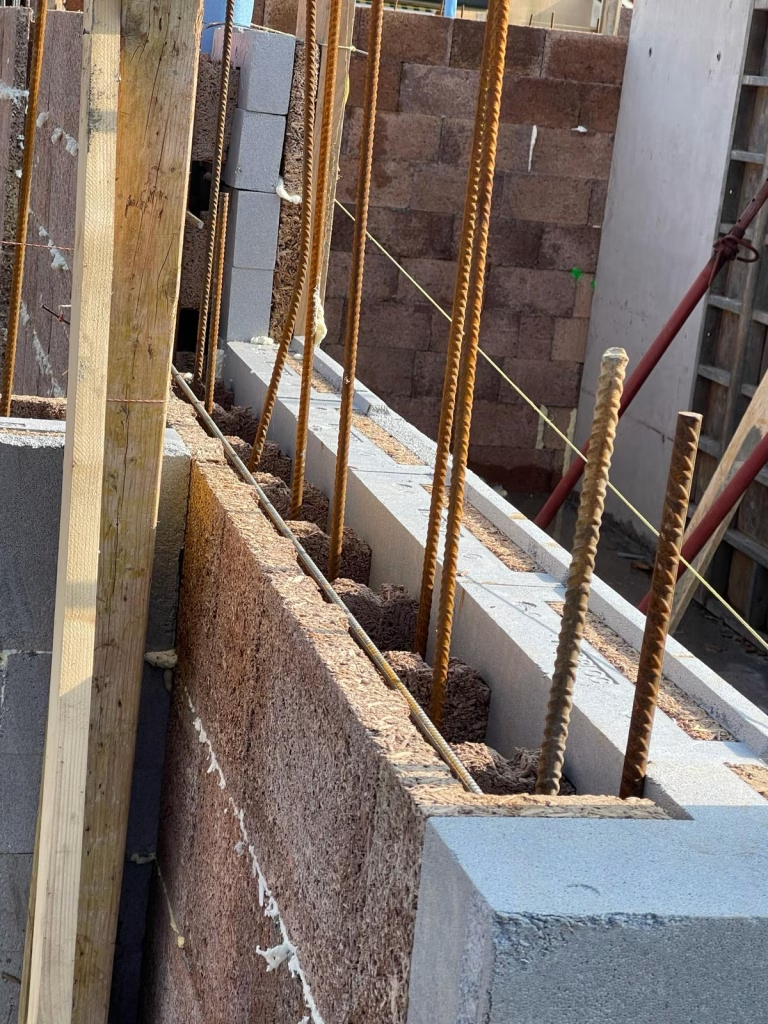
If a complete floor is to be poured, we recommend applying a low-expansion foam polyurethane adhesive to each row of blocks. This adhesive should be applied horizontally to the inside and outside walls to prevent movement.
Choix de l’épaisseur du béton (zone non sismique) :
| Épaisseur | Usage | Avantages | Inconvénients |
| 12 cm | Minimum pour murs extérieurs. Suffisant pour la plupart des maisons individuelles standards. | Économique (moins de béton). Conforme à la norme. | Marge de sécurité et performances (thermique, acoustique) moindres. |
| 14 cm | Choix pour des contraintes spécifiques ou pour une qualité perçue supérieure. | Robustesse accrue, meilleure durabilité, inertie et acoustique légèrement améliorées. | Coût légèrement plus élevé (plus de béton). Pas toujours nécessaire. |
Floors and slabs
All floors on the market are compatible with the Fixolite system. After cutting the blocks, the floor is positioned on the block wall.
The floor will be supported by props; under no circumstances should the blocks be used to support the floor before and during pouring.
It is also advisable to refer to the floor manufacturers' recommendations before installation (floor thickness, weight, etc.).
Finishing work
Window sills
All windows on the market are compatible with the Fixolite system.
Before fitting the window sill, insulation should be placed in the cavities of the block to avoid thermal bridges. The customer will supply, cut and glue these elements. To complete the insulation, the notches will also need to be filled. A thickness of 80 mm of Styrofoam insulation is recommended.
The window sills will be glued with PU adhesive. A bead will be applied to the wood fibre/cement assembly to ensure moisture and air permeability. A pump seal will complete the seal at the block/sill connection (inside).
Additional insulation will be added in front of the sill (on the inside) to complete the insulation. XPS is recommended for this additional insulation.
Balconies
Thermal breaks must be used to limit thermal bridges.
Swing shutters
Hinged shutters must be fixed to the concrete wall. The most common solution is to use chemically sealed threaded rods. However, it is advisable to follow the recommendations of the shutter manufacturer and use his materials.
The closure manufacturer should be informed of the thickness between the hinges and the concrete shell so that they can supply the appropriate materials.
Openings
As the installation of joinery is recommended in tunnels, the joinery reservation plans (finished dimensions of the joinery) must be obtained (all manufacturers of openings provide this information). The blocks should be installed with the overall dimensions +10 mm to ensure watertightness. The same information should be requested for garage doors or other joinery.
Joinery
Fixolite blocks can be fitted with a wide range of fixings. Tunnel and rabbet fixing are the most common. There are several possible fixing systems: fixing from the concrete wall (recommended by the CSTB), fixing to the wood fibre/cement (density 510 kg/m3) or fixing into the insulation (by adding a stud).
Whatever the case, the recommendations of the opening manufacturers should be followed to ensure that the assembly is watertight and resistant.
Technical ducts
There are two possible solutions:
- In most cases, ducts (water or electricity) are positioned in the thickness of the concrete shell before casting. However, care must be taken to ensure that this does not affect the overall performance of the structure, and a concrete study should be carried out to validate this possibility.
- Fixolite blocks can also be grooved (after the concrete has been poured and dried) to allow technical ducts to pass through. Since Fixolite blocks do not add any mechanical strength to the structure, grooving can be considered. This method is mainly used on projects where the continuity of the concrete walls cannot be altered (acoustics, fire resistance, for example).
Revêtement avec briques de parement
- Si la surface est bien plane, appliquez directement une colle avec un treillis en fibre de verre à maroufler (exemple : colle Armatop Quattro et treillis Alsitex Glasfasergewebe de chez Alsecco)
- Si le mur est irrégulier, nous conseillons l’application d’un dégrossi avec un treillis en fibre de verre à maroufler (exemple : sous-enduit Armatop Quattro et treillis Alsitex Glasfasergewebe de chez Alsecco).
- Ensuite application de la colle pour la finition (exemple : colle Armatop Quattro ou enduit de finition Alsilite Sc Carbon T de chez Alsecco)
- Remarque : si les briques de parement nécessitent des supports, fixations ou ancres à clouer, le bloc HI ne convient pas. Seul le bloc H ou classique est adapter.
Revêtement avec enduits
- Si la surface est bien plane,
- appliquez un primaire d’accrochage (exemple : primaire Haftgrund de chez Alsecco);
- ensuite appliquez l’enduit l’enduit de finition avec un treillis en fibre de verre à maroufler (exemple : enduit de finition Alsilite Sc Carbon T et treillis Alsitex Glasfasergewebe de chez Alsecco).
- Si le mur est irrégulier,
- appliquez un dégrossi avec un treillis en fibre de verre à maroufler (exemple : sous-enduit Armatop Quattro et treillis Alsitex Glasfasergewebe de chez Alsecco);
- ensuite appliquez l’enduit l’enduit de finition (exemple : enduit de finition Alsilite Sc Carbon T de chez Alsecco)
Remarque pour murs extérieurs avec blocs HI : ces murs ne sont pas respirants, ils s’adaptent parfaitement aux enduits non perspirants. Les enduits modernes sont donc particulièrement recommandés :
- Organic coatings These are made from synthetic resin (acrylic, siloxane, etc.) and are ideal for use with expanded polystyrene and other synthetic insulation materials. This solution, often the most economical, allows a thin coating to be applied, sometimes in a single coat.
- Cement coatings This type of hydraulic rendering is well-suited to EPS, as cement blocks all breathing capacity. Although it takes longer to apply and is therefore more expensive, it has the advantage of being less polluting than organic coatings.
- Cement and lime renderings (mortar bâtard) If you're looking for a more traditional look over non-breathable insulation, mortar bastard, which combines cement and lime, is an interesting option. It offers the classic appearance of lime rendering, but without its breathable properties.
Il convient d’interroger les fabricants d’enduit afin de connaître les meilleures solutions qui tiendront compte de plusieurs facteurs comme notamment : la situation géographique (bord de mer, montagne …) ou la période d’application des enduits (gels, chaleur, pluie ou ensoleillement).
These recommendations also state that renderings must be reinforced on all facades. The type of reinforcement (PVC or steel) will be defined by the rendering manufacturers according to the type of rendering recommended.
Recycling
- Insulation: this should be separated from the wood fibre/cement and taken to a recycling centre. As the insulation is not glued, separation is quick and easy.
- Wood fibre/cement : As wood is mineralised with lime (a natural treatment), these elements can be stored with the rubble.